Cervical Spine Assessment
Get your cervical assessment right! Use this as a quick reference or to brush up on your skills!

Introduction
Well, I couldn’t go and do a lumbar spine assessment blog post without this one for cervical spine!
Again, this isn’t fully comprehensive; it’s designed to be a good starting point! Other things may often need to be added, and some may not be relevant for certain patients. Clinical judgement is key!
We will cover the following key areas:
- Range of Movement
- Shoulders/Upper Limb Assessment
- Myotomes
- Reflexes (including silent reflexes)
- Upper Motor Neurone
- Sensation
Range of Movement
A nice simple one to start. It will tell you if there is any restriction and if so, then it’s time to consider why this is the case. Hands on can be key here in terms of isolating the movement from the shoulders and the thoracic spine. A simple hands on the shoulders here can be really useful as a bit of tactile feedback to stop this.
Movement is best assessed in sitting, as it helps to isolate cervical movement further.
It will provide you with some information about pain behaviours, muscular tightness and if any movement provoke dizziness or other symptoms, then these can be assessed further

Note: Stiffness to the neck is important to look for when there is suggestion of headaches and any other signs of potential meningitis - see our follow-up post HERE for more information on Meningitis and what to look out for. In a nutshell - this will be true neck stiffness and not just movement restricted due to pain
[[Meningitis - What you need to know in MSK]]
Shoulders/Upper Limb Assessment
Start with observation. Look for:
- Muscle Wasting
- Abnormal movements/tremor
- Colour changes
Test for (as a minimum):
- Power
- Range of Movement
- Tone
Here, it’s always worth going through your general shoulder assessment to help with excluding these as a cause for any upper limb pains, especially when a patient has radicular symptoms.
Put things into context here... what previous injuries are there? Previous surgery? Upper limb/shoulder problems already? Consider that sometimes there is not only one cause so look to assess fully if not sure!
Myotomes
Always part of the assessment I find people fear, miss out or generally think they have done but haven't. What do I mean? You need to consider what you are looking for and what movements correspond to which nerve root. Myotomes by their nature are specific to one spinal level so yes, you do need to be specific, but it doesn't need to take forever.
Yes, all copied and pasted from the Lumbar Assessment Post but key here as I find people generally think they’ve done a myotome assessment for the cervical spine without actually doing it...
In the Upper Limb the myotomes are a little more overlapping with some nerve roots doing more than one movement, so look out for this and test both. If both are weak then the myotome is weak, if one is weak, it is less clear and could just be that particular movement or peripheral branch.
| Movement | Nerve Root |
|---|---|
| Neck Flexion | C1-2 |
| Neck Side-Flexion | C3 |
| Shoulder Elevation | C4 |
| Shoulder Abduction | C5 |
| Elbow Flexion | C5-6 |
| Elbow + Fingers Extension | C7 |
| Finger Flexion | C8 |
| Finger Abduction, Adduction and Thumb Abduction | T1 |
Reflexes
So hopefully by now you know that reflexes are ‘An automatic and stereotyped response to a specific sensory stimulus that involves the spinal cord’. So basically... predictable. If less response, too much response, absent (or in some cases present) then this can indicate a problem with the spinal cord.
Usually for most of these you are hitting your thumb with the reflex hammer to isolate the tendon without causing too much discomfort.
| Reflex | How to Test | Response | Spinal Level |
|---|---|---|---|
| Biceps | Elbow in slight flexion, find biceps tendon, thumb over tendon, hit thumb with reflex hammer | Elbow flexion | C5 |
| Brachioradialis | Forearm in supination, find radial styloid process and go 2-3cm above this, hit tendon through thumb with hammer | Supination of Forearm | C6 |
| Triceps | Elbow in flexion and shoulder abducted, find triceps tendon, hit tendon with hammer | Elbow Extension | C7 |
Upper Motor Neurone Testing
Hoffman's sign!
This tests for an upper motor neurone lesion in the Upper Limb, a bit like Babinski in the lower limb (very simplified way of looking at it). Depending on your patient and what else you are considering/they present with, you may test both Babinski and Hoffman’s - be guided by the patient presentation.
Hoffman's test involves you holding the patient’s middle finger and then sharply flicking the fingernail. The ‘normal’ is that nothing else happens. The positive is that the thumb involuntarily adducts and flexes and the middle finger flexes.
As with Babinski - this isn’t definitive on its own but means you need further investigations to look for the possibility of an Upper Motor Neurone problem - usually MRI.
Cranial Nerves
I thought these should be mentioned here too. Generally most of these are assessed with your subjective questioning but always with know what they are and what patients may present with if they have a problem with one of these:
| Cranial Nerve | Name | Primary Function(s) | Additional Details |
|---|---|---|---|
| I | Olfactory | Smell | Provides the sense of smell. |
| II | Optic | Vision | Transmits visual information from the retina to the brain. |
| III | Oculomotor | Eye movement, eyelid and pupil control | Opens and moves the eyes, adjusts pupil width. |
| IV | Trochlear | Eye movement | Enables downward and inward eye movement (toward or away from nose). |
| V | Trigeminal | Facial sensation, chewing | Provides sensation to the face, eyes, mouth; controls muscles for chewing. |
| VI | Abducens | Eye movement (abduction) | Moves the eyes from left to right. |
| VII | Facial | Facial expression, taste, salivation | Controls facial muscles for expression and taste in part of the tongue. |
| VIII | Vestibulocochlear | Hearing and balance | Responsible for auditory perception and equilibrium. |
| IX | Glossopharyngeal | Taste, swallowing, throat sensation | Provides taste and throat sensation; assists swallowing; regulates saliva and blood pressure. |
| X | Vagus | Autonomic control of thoracic and abdominal organs | Regulates heart rate, digestion, breathing, mood, and parasympathetic functions. |
| XI | Accessory (Spinal Accessory) | Neck and shoulder movement | Controls movement of the sternocleidomastoid and trapezius muscles. |
| XII | Hypoglossal | Tongue movement | Controls tongue motion for speaking, eating, and swallowing. |
As you can see from that most are covered by your red flag questioning but a problem with some of them may only be covered with questioning further or when the patient tells you about ‘weird’ symptoms they are experiencing. Worth keeping at the back of your mind or downloading our handy card for clinic!
Sensation
Finally: sensation! As per my Lumbar Spine post HERE the sensation is quite subjective (even though it forms part of your objective assessment) it's important to compare each side, have a systematic approach and ask the patient to identify any large changes in sensation and not just very minor (as you might have just tested with less pressure).
Here is my link to Neurotips again, as I think they are a really useful tool that is very overlooked and allow you to test easily and systematically. Not sponsored though (I wish!)
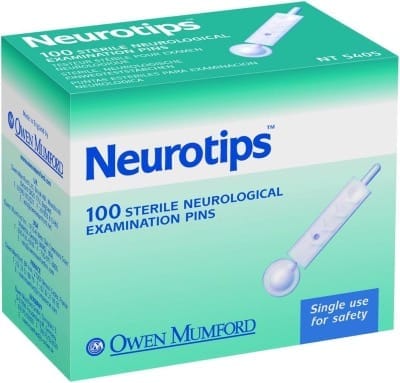
Link for purchase: https://amzn.to/42LkDGj
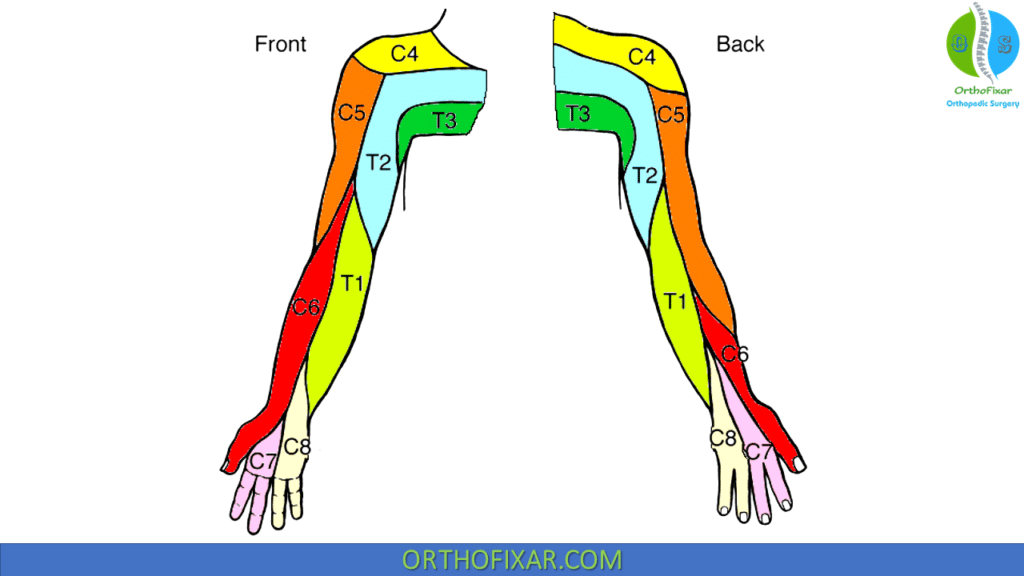
The difference in the upper limbs with sensory testing, as the dermatomes tend to overlap quite a bit. If your patient is getting some changes into the fingers (and you don’t think it’s peripheral, like (Carpal Tunnel Syndrome LINK TO POST) then you’re laughing as these are more specific! If not, then I wouldn't reliably rely on the findings for diagnosis.
All charts are slightly different, but here is a nice basic and colourful one:
I've also cropped the ‘Key Areas’ chart to the arm to show this in more detail:
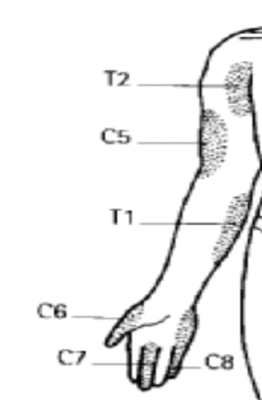
Like I said it’s mainly the hand if you’re looking for specifics to point you in the right direction in terms of potential nerve root level as there’s a lot of overlap.
Case Study:
Wrap up!
So there you go hopefully this has been helpful. Here is a link to the quick reference charts that you can use in clinic:

Please do consider purchasing as it will really help us keep producing good content for you! Plus let us know in the comments below what else you’d like to see!


